Today we have featured Shoulder Flexibility Solution Review, with its pricing policy, pros, and cons, we have also covered the bonus package, so read our detailed Shoulder Flexibility Solution Review…
Tightness in the shoulders is a common problem faced by many people these days. This, in fact, leads to a lot of pain, bad posture, and a lack of flexibility.
Many times we try to stretch ourselves and get rid of the tightness but in vain. However, a lot of people face an issue in terms of flexibility and tightness in the shoulders which they cannot get rid of.
Tight shoulders can be the reason behind poor flexibility. Now, this is not a very happy place to be in and can also be painful and result in poor posture. To get rid of the tightness people try to stretch and maybe this also doesn’t help. So read our detailed Shoulder Flexibility Solution Review.
Well, if you are experiencing problems like these, then you need to understand that you are not the only one. Around 70% of the total population is dealing with one or the other kind of issues related to flexibility and shoulder tightness. Getting rid of this can be a tricky affair.
To deal with the above-mentioned issues Coach Eric Wong has come up with an awesome answer known as the shoulder flexibility solution. He has been hugely successful earlier also with the “Ultimate MMA Strength and Conditioning Program”. This time the focus is on shoulder flexibility routines.
If you intend to get rid of these issues, a program has been designed by Eric Wong which will help you out – the Shoulder Flexibility Solution Review.
Bottom Line Up Front:
The Shoulder Flexibility Solution program is designed to enable you to perform your usual workouts without any trouble or pain, improving strength and flexibility The coach Eric Wong returns with his Shoulder Flexibility Solution PDF to cope with.

Its great success after trying, So anyway I went online and grabbed Eric’s Shoulder Flexibility Solution and have watched the entire package I highly recommended, Shoulder Flexibility Solution Review check out now

3D Flexibility System – What Is It?
There are nine main factors that have been addressed to create this flexibility system which we shall discuss in detail in Shoulder Flexibility Solution Review.
1. Reflexes: If the flexibility system has to work, this factor must be considered
2. Joint Stabiliser: This is an automatic function of the muscles that prevents any damage to the joints
3. Muscle: These are Fibres that have to be correctly stretched
4. Joint Capsule: This is responsible for the majority of the restrictions in flexibility
5. Fascia: This is the Muscular connective tissue that could develop adhesions or scars

6. Control: It is the ability of an individual to control the muscles consciously
7. Tolerance to Pain: The right level has to be achieved to advance in the program
8. Core: It refers to Deep musculature which stabilizes the abdomen and the back
9. The Prime Mover: These are the Muscles that begin and end the range of movement of the individual.
The Functioning Of Shoulder Flexibility Solution
Silence is the essence of this result-oriented program. With the help of an all-natural approach, you will be able to achieve the program targets. You will be able to strike back with zeal with the help of Shoulder Flexibility Solution.
The program is scientific and you can stay assured of getting great results.
With the help of the static stretching method, you will be able to achieve complete relaxation of the muscles without putting in any extra effort.
The creator of the program has complete confidence in the static stretching method and is well aware of its positive effect in improving shoulder flexibility in an awesome manner.

The workout plan of the program will actually play a crucial role in drastically reducing muscle tightness and adding beauty to body posture. And the biggest advantage is the fact that the program is not associated with any kind of harmful method.
It is totally safe and very effective. The all-natural and easy-to-follow techniques make everything a piece of cake and there is no need to add any extra supplements.
It is a superb idea to go through the shoulder flexibility program and get to know all about its authenticity.

There are six distinct routines and each routine will require twenty minutes or less to finish off. These six routines complete the Hip Flexibility Solution Review.
Altogether, these distinct routines focus on every single factor of flexibility that has been listed above and they give you a complete result in terms of speed, strength, power as well as mobility in addition to getting rid of the pain.
About Eric Wong
Eric Wong is no strange name when it comes to fitness and MMA. He is a professional coach in strength and has been a coach to many fighters in the sport of MMA like Claude Patrick.
You will find his work featured in a lot of publications that consist of “Spike”, “Fighting Fit” “UFC,” and “MMA”.

He is the author of many programs that have been designed and created to assist athletes as well as normal people like us to stay fit by way of many effective methods that he has used with his clients.
And they specialized in exercise physiology and biomechanics. He also has mastered kinesiology from the University of Waterloo.
What Exactly Is Meant By Shoulder Flexibility Solution?
We all must be aware that one of the common methods to loosen up the shoulders is static stretching.
However, according to Eric Wong, static stretching is, in fact, amongst the very less effective methods to improve the flexibility of the shoulders and get rid of the tightness. This entire program is based on science and is quite easy for users.

The Shoulder Flexibility Solution Review consists of the following routines:
Routine #1: This routine will help you touch your hands behind the back. According to Eric, it is abnormal if you cannot touch your hands and this indicates that your body has problems.
This routine focuses on releasing those issues that are important to build strength but have been
Routine #2: This routine will help you get the perfect head position that will give you a healthy neck, jaw, and spine.

In case you feel that your head leans way too forward, then this routine will definitely assist you in switching things around to get the perfect posture which will promote better overall well-being.
Routine #3: This specific routine will assist you in increasing the range of motion as well as reaching overhead. The routine focuses not just on your shoulder, but even on the thoracic spine as well as the core.
Some More Routines (Shoulder Flexibility Solution Review)
Routine #4: This routine will help the client fix the problem related to rounded shoulders and it will sit in the posture automatically which will be advantageous to the strength, spine, and flexibility.
Routine #5: This specific routine will help you fix issues in the shoulder blade which is positioned abnormally and also is protruding from behind. This issue could cause injuries that must be looked into.

Routine #6: This routine will help you enhance the mobility of your shoulders. This routine must be done prior to the workouts and this will enable you to lift things with less effort.
The Shoulder Flexibility Solution consists of a system which is called the System of 3D Flexibility and this addresses the reasons why the shoulders of a person are light.
This assists you in getting the desired flexibility and does not cause pain.
It also improves the stability of joints which helps in relaxing the muscles as well as enhances the ability to control the muscles and this, in turn, will improve flexibility as well as strength.
More About The Routines:
It is important to pay attention to the fact that there are two forms of the routine. These are in the video as well as a PDF form. You will get to know all about the stretches to be pursued from the PDF.
You will be getting two different choices with the video, namely, download or stream them to your computer in SD or HD.

You will get to know all about the movements as well as stretches from the videos. There will be no scope of confusion after watching the videos. Also, the audio quality is pretty awesome.
Thus, you get to watch as well as hear everything without any confusion. You will be happy to know that the techniques do not involve much of the equipment or machinery and can be carried out with great ease at work, home or gym.
Shoulder Flexibility Solution Review: How To Improve Range of Motion in Shoulders?
You must be knowing about a common problem called shoulder tightening. If not taken care of, this problem results in body pain, lack of flexibility, and bad posture.
A very effective Shoulder Flexibility Solution is introduced by Eric Wong, which can cure y our problem of shoulder tightening.
We’ll get through all the points which can effectively release the tight shoulders, but before that, let’s talk about the reasons and the prominent symptoms of this problem.
Most people face the issue where their shoulders don’t get flexible enough and become stiff. shoulder tightening can lead to poor body posture and many other associated problems such as:
- Not being able to make your hand reach behind your back
- Neck ache and tightness
- Rotator cuff problems
- Nerve impingements
- Wrong and bent body posture
- Forward head
- Hardship to reach overheads and doing exercises of overhead
These are prevalent issues which cause due to shoulder tightening. To cure this problem, people often do stretch, but it doesn’t work well for a long time.
But Shoulder Flexibility Solution is beneficial to fix all of these issues permanently.
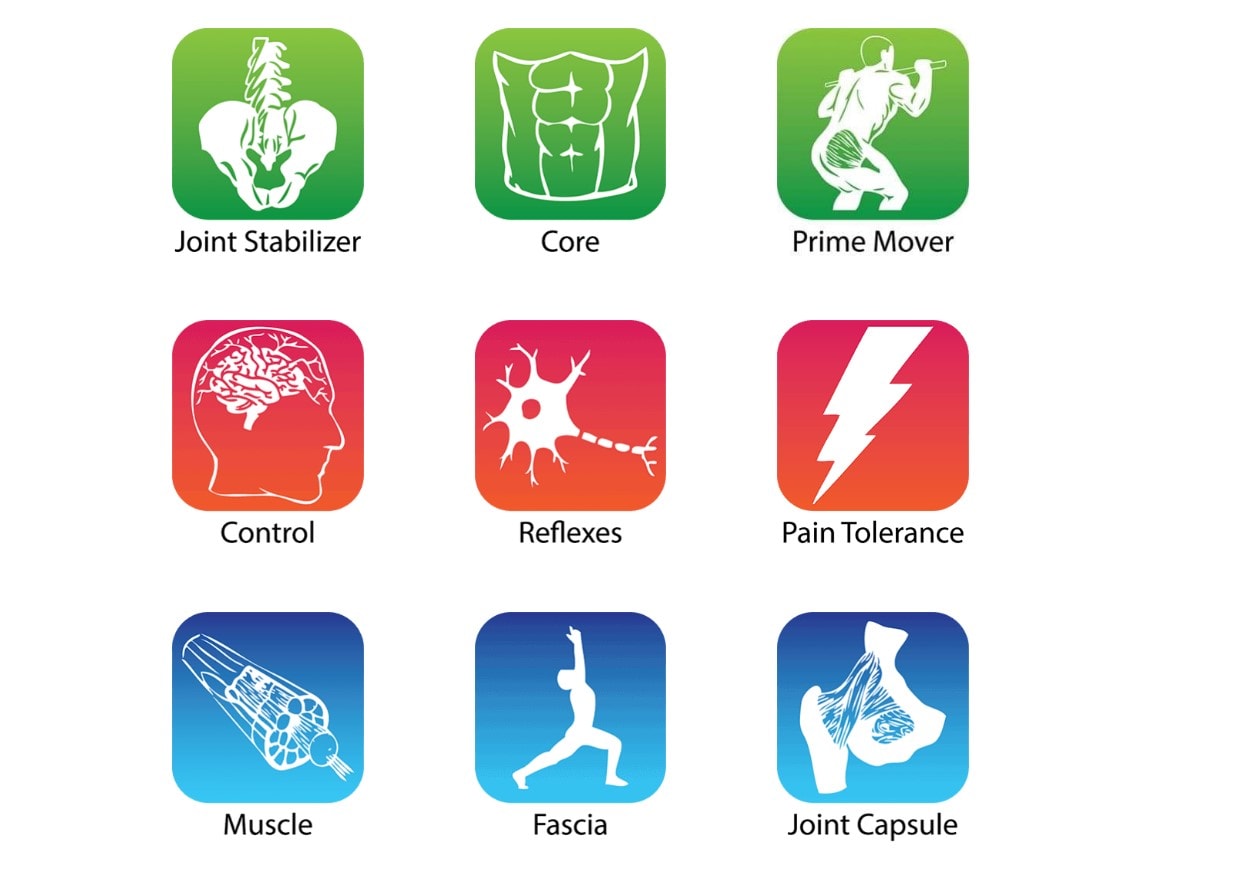
Eric Wong has ascertained 9 different factors that must be undertaken to ensure fast improvement in flexibility of shoulders.
This is known as the 3D Flexibility System; here’s a list of these factors –
- Joint stabilizer
- Core (which includes deep back and abdominal muscles)
- Prime mover (muscles that help you to move in and out of the motion range)
- Control (being able to respond to any feeling and relaxing your body muscles)
- Reflexes of body
- Pain tolerance
- Muscles
- Fascia (organizes the muscles)
- Joint capsule
Not being able to do your daily routine work and play sports properly because of having a stiff and tight shoulder can be a big problem in the future if not taken care of now.
Shoulder Flexibility Solution can be effective and helpful. When your shoulders get a release, you will perform all those sports, and work your effort of doing them will decrease to half of it.
In Shoulder Flexibility Solution, there is an efficient and impactful system following which you can release your shoulders and get rid of shoulder tightening forever.
Shoulder Flexibility System Review
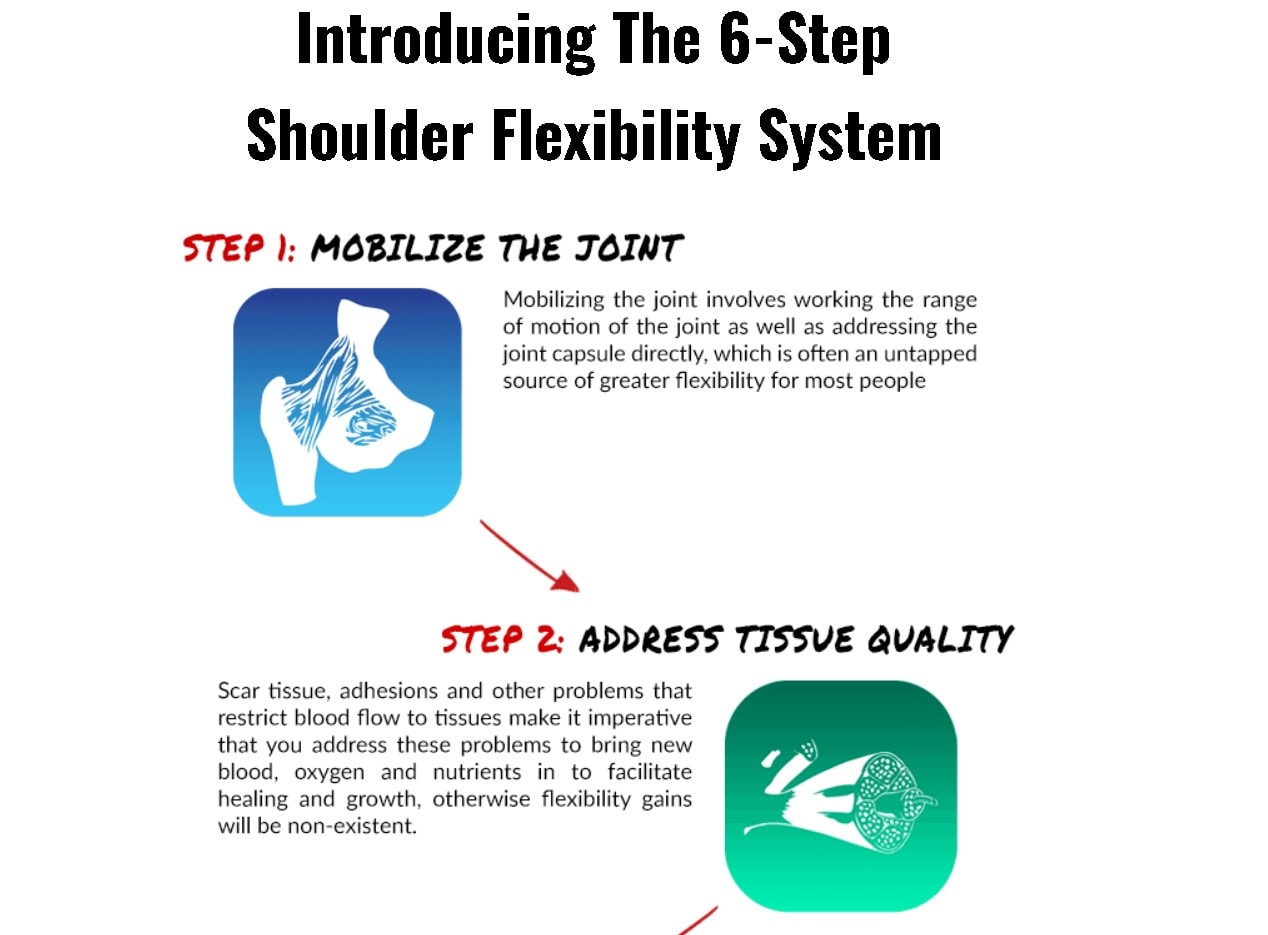
This system consists of six significant steps, which are mentioned below –
Step 1: Mobilize/Move your joints Making movements in joints includes working on the motion range of joints and directly tacking the joint capsule, which is the primary news source of impressive flexibility.
Step 2: Tackle the quality of the tissue.
Adhesions, scar tissues, and many other issues prohibit blood flow to tissues. You need to bring new nutrients, blood, and oxygen to your body to heal and grow your tissues more healthily.
Step 3: Deactivating the overactive muscles.
As these days body postures aren’t proper, some muscles of your body activate and take over when they should not, and therefore, they tighten.
Moreover, they cause weakness in those muscles, which they compensate. So, it is essential to have excellent and proper body posture to deactivate overactive muscles.
Step 4: Make a new cross bridge.
Whenever you attain a new length by mobilizing and stretching your body, you also require strength to sustain that length and flexibility.
If there is no such strength, then the flexibility will be lost after some time. Ensure to create a new cross-bridge, which is done by attaining more strength in your body.
Step – 5: Stabilisation of new row
Build strength in both of those muscles responsible for taking you into the motion range and those muscles that take you out of the motion range.
Step – 6: Functional integration
After you attain new length and strength into the new range of motion, you must link into the functional movement patterns to make sure that they are built into your neuromuscular system.
Following these steps can effectively help you to gain and sustain your flexibility.
What Are The Bonuses?
With this mind-blowing and unique product, you will be getting 2 bonus packages. These are the rotator hardening routine and the shoulder regen routine. Well, there is no need to get confused as these are pretty much similar to the core product when it comes to delivery.
The quality of the video is top quality, crystal clear, and has great content. These videos are in detail and you will be getting all the vital information.

Shoulder Flexibility Solution Review: What Can You Expect From The Product?
If you are facing one or the other kind of shoulder injury, stiffness, or pain, then you can simply rely on the usual stretches.
You will be requiring something extra and this is where you will be requiring this revolutionary product.
1. Benefits
There is no denying the fact that this amazing product is power-packed and will surely let things roll within no time. Read on to find out more about some of the fantastic stuff associated with this product.
2. Posture
Great posture has a major role to play in leading a confident and healthy life. With the right kind of techniques, strategies, and methods you will be able to achieve this goal over a period of time in terms of great posture.
This shoulder flexibility program is your one-stop destination for improving your posture in a remarkable and hassle-free manner.

3. Bonuses
The two types of free items that you will be getting with this program will help in ensuring that you get a perfectly flexible and pain-free body. With the help of the routines, you will be able to get a perfectly healthy life.
4. Simple
There is nothing complicated about this product and you will be getting to know all about the movements in the PDF and a video format. These are easy to comprehend and there is no requirement of any sort of complicated machinery.
The program is suitable for almost everyone. You can follow the techniques as these are simple and easy to follow.
Shoulder External and Internal Rotation Range of Motion Exercise
You’re missing a huge piece of the puzzle if you don’t include rotation in your shoulder workouts. This shoulder internal rotation exercise is a good one to try.
1. Looking Beyond Linear Movements
When it comes to shoulder training, most people have a one-track focus. With exercises like overhead presses and pull-ups, they concentrate on linear, pressing, and pulling actions.
These exercises are excellent but don’t overlook the importance of rotation in shoulder mobility.
As a result, shoulders with limited range of motion and strength in directions critical to how we utilize our shoulders effectively – internal and exterior rotation – may develop (IR and ER).
2. Poor Shoulder Rotation Mobility Causes Issues
A lack of rotation mobility in your shoulder can lead to a variety of problems.
Impingement is most likely the most common issue.
When you lift your arm overhead to complete a push or serve the ball in tennis, your humerus, or upper arm bone, may move wrongly and pressure other structures in the area if your shoulder rotators aren’t firing appropriately.
This pinching or impingement can be very painful and interfere with your ability to move and stay active.
When you don’t have enough mobility or rely on improper movement patterns, your rotator cuff muscles might develop painful tendonitis or tendinosis.
These muscles also serve to keep the head of your humerus in the shoulder socket by firing. If they’re not firing properly, or if your rotational range of motion is limited, and you’re forcing yourself to do repetitive motions like throwing a baseball, it could lead to a more serious shoulder problem like a labral tear.
3. Dissociating Movements
We’ll utilize a dissociation approach to solve these typical internal and external rotation limitations.
This approach is used to separate two typically occurring movement patterns. These strategies can help you develop stronger neuromuscular control over your movement at that joint by dissociating the actions.
We’ll look at how your glenohumeral joint and scapula move together with the dissociation exercise I’ll show you today.
The glenoid fossa is a shallow socket on the lateral edge of your shoulder blade, or scapula, where the head of your humerus resides. As a result, the movement of one of those bones is inextricably linked to the movement of the other.
Lifting your arms overhead, for example, requires not only upward movement but also external rotation of the humerus and upward rotation of the scalp over your rib cage.
When you rotate your arm away from your body or shift your shoulder into external rotation, your scapula retracts or draws against each other on their back.
Furthermore, when you inward rotate your shoulder or rotate your arm toward your body, your scapula protract or move apart from each other.
We’ll focus on your shoulder control by breaking up this rhythm and pairing the opposing actions.
This type of exercise will also improve the activation of muscles that let you enter and move deeper into a range of motion, resulting in increased strength and muscular extensibility.
The external rotators of your shoulders go from your scapulae to a point near the top of your humerus. As you begin to practice this exercise, you will most likely notice that your muscles heat up much more than usual.
This is because you’re expecting them to work in a range and position they’re not used to.
This shoulder external and internal rotation workout offers a lot of advantages, so try it out.
4. Exercising the Shoulder External Rotation
For the initial phase of the exercise, we’ll separate shoulder external rotation and scapular retraction and instead pair ER with scapular protraction.
- Begin with complete internal rotation with your elbows bent and your hands on your belly, then go into full scapular retraction by squeezing your shoulder blades together.
- Experiment with external rotation by rotating your hands away from your body while also trying to protract your scaps and move them away from each other.
- As you take a slow, deep 360° breath, pause at the end of your range of motion and maintain your muscles active and engaged in external rotation and protraction.
5. Internal Rotation of the Shoulders
Now we’ll look at how to separate internal rotation of the shoulder from protraction and instead link it with scapular retraction.
- Exercise for shoulder external rotation
- Begin at the conclusion of the preceding exercise, with your shoulders externally rotated and your scapulae extended.
- Internal rotation is achieved by retracting the scaps and pinching them back near each other as you move your hands back toward your stomach.
- You can sustain activation of the internal rotators by pressing your hands into your tummy at the conclusion of your range of motion.
- Maintain this internal activation and scapular retraction while you pause and breathe deeply.
Shoulder Flexibility Solution Review: How to Apply This Method?
The combination of these two actions represents one entire cycle of the dissociation method. I recommend starting with only three cycles. As you gain strength in the movement pattern, you can increase the number of cycles to 5 or 6.
Try to rotate your humerus at the same pace as you move your scapulae as you do the exercises.
Also, don’t just sit back and rest when you come to the limit of your range. Instead, keep both movements active as much as possible.
Finally, focus on your breathing. Stay active while taking that deep 360° breath, inhaling not just into your chest but also into your back and sides.
This method of incorporating your breath will help you enhance your endurance and better integrate the movement pattern into your neural system.
This shoulder external and internal rotation exercise is a perfect warm-up before a workout that includes any shoulder movement. It will assist to engage your muscles, firing them up while also boosting your range of motion and shoulder control.
And if you think you may benefit from greater shoulder control, you should certainly check out my Shoulder Control Program. This is a three-phase progressive training that finishes in functional integration, which can boost your performance in the gym or athletics.
Serratus Anterior Exercises To Maintain A Healthy Shoulder
Working on your serratus anterior will maintain your shoulders flexible and strong, allowing you to prevent injury and live an active life.
You may be unaware that you have serratus anterior issues. You might not even know what a serratus anterior is (we’ll get to that in a minute).
But I’m sure you’re aware of how powerful your shoulders are.
serratus-anterior-exercises-anatomy
You know how hard you can punch, how high you can go on the military press, and how powerful and sturdy your shoulders feel during push-ups…
If your shoulders have been feeling a bit weak or achy recently, it’s possible that your serratus anterior is to blame.
What exactly is the Serratus Anterior?
The serratus anterior is most recognized by its serrated-looking appearance along the side of your body.
Depending on your body type and how shredded (or not) you are, it may or may not be partially visible underneath your armpit during certain motions.
Your serratus anterior normally begins on your first eight ribs, but it lays deep to your pectoral muscles, so even on a very slender physique, you won’t be able to view all of these “serrations.”
Your serratus anterior extends from the ribs and wraps around your side and back, where it goes below the scapulae (or shoulder blades) and joins to the medial border of the bottom of your scaps.
What is the function of the Serratus Anterior?
Because of its attachment to the medial undersurface of your scapulae, the serratus anterior is not only excellently positioned to conduct particular shoulder blade motions, but is also essential for scapular stability.
The most fundamental function of the serratus anterior is to protract your scapulae (wrap forward over your ribcage), which helps to push actions of your arms, such as in a pushup.
This muscle also collaborates with the lower and upper trapezius muscles to rotate the scapulae upwards during shoulder flexion.
Scapulohumeral rhythm, or the synchronized movement of your scapula and upper arm bone, is essential for overhead and horizontal pushing and pulling.
However, one of the most critical jobs of your serratus anterior is to maintain scapular stability during glenohumeral, or shoulder joint, movement.
This vital function is accomplished in part by posteriorly tilting your scapulae.
Posterior scapular tilt is vital for healthy shoulders because it keeps the subacromial space between the acromion process of the scapulae and the head of the humerus open. A lack of room in this location might result in a painful condition known as shoulder impingement.
Furthermore, if your serratus anterior is not correctly stabilized, you might develop a condition known as winged scapula. When this happens, the scapula’s medial edge begins to flail.
What can induce Serratus Anterior dysfunction?
A multitude of reasons can induce serratus anterior dysfunction, which can eventually lead to difficulties including impingement and scapular winging.
Damage to the long thoracic nerve, which travels from your neck down the side of your body to innervate your serratus anterior, is one such issue.
If the nerve is unable to adequately convey impulses instructing your serratus anterior to contract, the muscle will weaken and become dysfunctional.
Long thoracic nerve injuries can develop if the nerve is stretched or compressed between its origin in the neck and its journey through the torso.
This might happen while participating in activities such as archery or tennis, or after carrying large luggage over your shoulder for a lengthy period of time.
Contracted, inflexible, or hyperactive muscles, particularly your shoulder internal rotators and pec minor, can also cause serratus anterior dysfunction.
Internal rotators in your shoulders, such as the subscapularis and pectoralis major, contract to rotate your arm in towards the midline. When these muscles are overworked, they can force the shoulder into excessive internal rotation, causing the midsection to collapse.
However, if your pec minor is hyperactive, it might inhibit the serratus anterior from correctly moving your scapula during critical activities like raising your arm overhead.
Minor serratus anterior pectoralis. There’s one more item I’d like to mention that can cause serratus anterior dysfunction – and it’s a significant one.
You might have heard somewhere along the line to keep your shoulder blades “down and back.”
If you take this advice to heart and constantly remind yourself to keep those scaps down and back, you’re basically training your body to program the serratus anterior out of the exercise.
What are some common problems associated with Serratus Anterior dysfunction?
Weakness in your serratus anterior might contribute to scapular dyskinesis or incorrect alignment and movement of the scapulae. This can happen in a variety of ways.
If the serratus anterior weakness is combined with tight pecs and a tight deltoid, the scapulae may begin to tilt forward. As a result, the shoulders may begin to curve forward, and excessive thoracic spine kyphosis (aka a hunchback in the mid-to-upper back) may occur. It’s not a nice look.
When serratus anterior insufficiency is combined with further weakness in the lower traps, the medial border of the scapula flares up, resulting in the scapular winging we discussed before.
When this happens, the medial border of the scapulae may be seen sticking up from the back like wings.
Sometimes winging causes no symptoms [6], while other times it causes discomfort or weakness. However, scapular winging is a strong indication that there are problems and abnormalities in the shoulder joint that must be addressed.
If your serratus anterior fails to manage your scapulae adequately, the amount of space in the shoulder joint might be limited, resulting in the “grabbing” of muscles and ligaments that characterizes impingement.
Without enough space in the subacromial area, any activity that places your arms at or above shoulder level may result in shoulder impingement and a painful pinching feeling.
This impingement might cause inflammation of the bursa or rotator cuff tendon over time. Bursitis or tendonitis can develop with enough time and discomfort. And it may have all started with weakened serratus anterior!
How to Strengthen and Restore Serratus Anterior Function?
So, what should you do if your serratus anterior is twitching? This is where my 4-Step Process for removing pain, improving mobility, and building strength come into play.
- The first step is to address structural limitations.
- The Second Step is referred to as “Dissociate to Activate.”
- Step third, Extend the End Range
- The fourth step is functional integration.
The first step is to address structural limitations. Movement limits that limit your flexibility are known as structural limitations.
If you don’t have the flexibility to passively attain a range, you won’t be able to aggressively enter that range! This is why we must first address the structural constraints that are producing flexibility restrictions. ASMR is characterized by an active contraction of muscles that are diametrically opposed (antagonists) to those being rolled or massaged (agonists).
We are evoking a neuromuscular reaction known as reciprocal inhibition by vigorously contracting the antagonists. Reciprocal inhibition occurs when the muscle group opposing the one being contracted relaxes instinctively.
“Dissociate to Activate” is the second step. Disrupting widely related Movement and/or Activation Patterns (M/Aps) is required for this phase.
There are M/APs that are often related, in which one movement or activation pattern immediately leads to another.
Disrupting faulty M/Aps can aid in the correction of habitual difficulties, the activation of inhibited muscles, and the encouragement of eccentric contractions, which have been demonstrated to be useful for strength training.
The third step is End Range Expansion. This stage entails executing exercises according to a precise protocol designed to assist you to increase your range of motion as well as your capacity to produce STRENGTH within that range.
You’ll intentionally enter the end range first, then develop tension in the muscles that got you there and hold it. After that, you relax the muscles while maintaining the joint posture before producing muscular tension to assist you escape the range.
End Range Expansion sequences are essential for developing strength in new ranges after removing structural constraints and dissociating incorrect movement patterns.
Step 4 is the last but not least: Functional Integration. This final phase assists you in transferring your gains to the gym, life, and sport – which is really what it’s all about, isn’t it?
But what defines a “functional” exercise?
The fact is that it is entirely dependent on you and how you need or want to operate in your life. The function is a concept that is specific to your personal objectives.
I’ve made the exercises in Step 4 very adaptable to any activity because I want them to be effective for you, whether you want to go to the gym, golf course, dojo, pool, or elsewhere.
The Functional Integration techniques I give often include more than one joint and trend more toward closed chain vs open-chain motions. The exercises will assist you in integrating newly acquired ranges and strength, as well as activating a muscle area in various patterns.
Shoulder Flexibility Solution Review: New Shoulder Mobility Workout
If you’re searching for one shoulder mobility exercise to do – whether it’s in your warm-up, cool-down, or as part of your workout to enhance your mobility – you won’t find a better one than this, since it offers the following benefits:
It works your shoulders through all of their end ranges, including flexion, extension, abduction, adduction, internal and external rotation.
As a result of the preceding statement, it places stress on connective tissues, pushing them to become stronger (use it or lose it).
Another advantage connected to the first is that it increases blood flow to all of the muscles and connective tissues, which is required for optimal tissue health via cellular respiration.
Growing Stiff, Painful, Immobile, And Frail Is A Natural Part Of The Ageing Process
This is only an idea. Nothing else.
Here’s the truth:
We have no control over things like time or our DNA.
All we can do is set a goal, learn as much as we can, and then do the activities we believe will lead us to that goal, paying attention to the consequences and adjusting as needed.
Yes, some individuals are more fortunate than others.
I won a Sony Walkman in a school lottery announced over the P.A. system while I was in third grade. That was a really lucky day!
So, despite what many self-proclaimed self-help gurus will tell you, there is such a thing as luck, because none of us picked our DNA.
However, the quality and amount of purposeful activities committed over time distinguish people who continuously experience favorable “luck.”
Crush a bag of chips and a 2L Coke every day, and you’re likely to be viewed as a really unfortunate person if we’re talking about health.
However, replace it with a salad, steak, and brisk stroll, and that person’s health luck is likely to be judged as much better at 60, 70, and beyond, regardless of genes.
Since movement longevity has surpassed maximal performance (strength, power, conditioning, etc.), I’ve switched from 2-3 days per week of hard pressing to 1-2 days per week of heavy to moderate pressing, and I’ve incorporated drills like today’s on a daily basis.
I appreciate blood flow because it transports oxygen and other nutrients.
But is it possible to have both peak performance and peak health?
I’m not going to say no, but the consideration becomes time and energy, and with a business to run and two small children to run with, I’ve accepted that I can’t “have it all.”
So, without further ado, here’s the shoulder mobility exercise I’m most fond of right now.
Shoulder Flexibility Solution Review: Should I Exercise When I’m In Pain?
If you read my comments, you’ll notice that the first step is to distinguish between different forms of pain since they require different treatments. And diverse sources of pain, such as muscles, nerves, and connective tissues in joints.
Here are some basic explanations of the most frequent forms of pain that active individuals feel, as well as ways to deal with them.
1. Muscle Soreness
Known as Delayed Onset Muscle Soreness (DOMS), it often feels like a general soreness over the entire muscle. It is caused by training the muscle at a high enough intensity to induce micro-damage, which is a prelude to building the muscle-up stronger than before.
Sore muscles are frequently only noticed when they are activated or poked, and the soreness normally subsides in 2-3 days at most, unless you entered beast mode after a lengthy break, in which case you should learn how to gently back into training.
“Unless the soreness is a 9-10 / 10, I advocate working through muscle discomfort but changing reps/sets according on how you feel, so if you’re at a 6-8 / 10, ease off the reps or sets considerably.” If you have a 5 or lower, stick to your program’s instructions.
It’s necessary to remain moving since blood flow promotes repair of any injured tissue; however, we don’t want to keep moving if it causes further damage. You will not do any extra harm if you follow the recommendations outlined above.”
“Oh and I’d avoid the ibuprofen and go by the pain rules I stated above — pain is your body telling you something and popping a painkiller is like putting on noise-canceling headphones while someone is talking to you – nasty!”
If the pain is 9-10 / 10, avoid the activities that produced the discomfort, but attempt to move/exercise in a way that does not cause pain, such as going for a stroll, swimming, or riding a bike.”
2. Burning Muscle
This is how it feels when you work out and enter the anaerobic glycolytic energy system, such as after completing Squat Jumps for 30+ seconds straight. This is commonly referred to as “lactic acid” in the muscles.
It’s only temporary and will go gone after you relax. It’s worth mentioning because it’s separate from the muscular pain discussed above.
3. Trigger Point
The soreness is more particular to a tiny (pointed) place vs. a painful muscle where the discomfort is throughout; trigger point pain is often very persistent throughout the day whether you’re utilizing the muscle or not.
The answer is to treat the compensation/dysfunction, and I often prescribe ASMR or massage for some short-term comfort.
4. Tingling
Tingling is usually caused by a nerve being stretched or squeezed. If you experience this during exercise, take a step back and continue in a range that does not induce discomfort.
5. Pin and Needle
The sensation of blood returning to an occluded extremity after a period of time. This used to happen to me a lot when I’d fall asleep on my bed.
6. Sharp Joint Pain
If you experience intense pain on the closing side of the joint while moving – for example, if you’re bending your elbow like doing a bicep curl and the sharp pain is on the inside of the elbow – you should stop because it signifies a pinching or ripping off one of the cartilaginous joint connective tissues.
If you’re experiencing this, you should try to avoid the acute pain as much as possible and get things operating properly, which may vary depending on the situation but will most likely require resolving tissue constraints, ensuring muscles are engaged and strong, and movement patterns are clean. [Doesn’t it seem like what we do here at Precision Movement?
7. Achy Joint
If your joints ache throughout the day, they’re probably inflamed. When it becomes chronic, it is generally referred to as osteoarthritis. In these circumstances, you must consider the most significant aspects of physical health, such as daily activity, exercise, diet, sleep, stress, and prescription medicine.
If it’s more temporary, it’s generally caused by a large amount of stress on the joint. For example, I get it in the winter because I’ll stay out there for hours playing outdoor hockey because I’m having so much fun (and in the back of my mind I still think I can make it to the NHL).
In both circumstances, I like contrast showers, so while in the shower, alternate 30 seconds of hot/as cold as possible on the body.
You now have some new pain vocabulary; the next time anything hurts, check if you can define it within one of these categories; it will give you a better understanding of what it is and what has to be done.
I recommend you store this email somewhere for future reference because if you want to live an active life, you will come across anything on this list sooner or later. It’s all part of the journey.
Instead Of A Levator Scapulae Stretch, Try THIS For Neck Pain
A basic levator scapulae stretch won’t help much with your neck ache. Instead, it’s time to go to the bottom of the problem so you can recuperate successfully.
1. Anatomy and Function of the Levator Scapulae
Your levator scapulae is a little muscle, yet it may have a significant impact on your pain and function.
This muscle originates in your neck’s first four cervical vertebrae and inserts into the upper corner of your scapula, known as the superior angle.
When the spine is stabilized, its major job is to raise your scapulae (thus the name).
Swimming, racquet sports like tennis or squash, and throwing a baseball or football all use this action.
With a modest downward rotation and an anterior tilt of the scapulae, it also aids in pushing your shoulder blades toward the midline.
This anterior tilt of the scapulae might become accentuated if you have a common postural condition known as forwarding head position. We’ll go over the forward head position in more detail later, but this is something to keep in mind.
The levator scapulae aid in the side bending and rotation of your cervical spine while your scapulae are fixed.
2. A Hurt in the Neck
Lugging heavy bags over your shoulder, sleeping with inadequate support, and, most importantly, POOR POSTURE can all lead to discomfort in this muscle.
Levator scapulae discomfort is often felt as trigger points in the neck, but it also causes limited mobility and, in some cases, severe migraines.
Another typical issue is referred discomfort from the levator. In certain circumstances, you may have pain below the shoulder or on top of the scapulae.
If you experience symptoms such as chronic headaches, shoulder discomfort, neck pain, or trigger points, you may do a few fast mobility tests to discover if a tight levator scapula is a contributing factor.
Keep in mind that while your shoulder blades are stable, contractions of this muscle might cause side bending and neck rotation. We’ll utilize these motions to evaluate if your levator scapula has the proper range.
Standing tall, side bend your neck, bringing your ear to your shoulder. You should be able to achieve a range of motion of roughly 45 degrees.
Next, maintain your shoulders steady while rotating your head to the side. You should be able to see straight out to the side at around 90 degrees.
Neck stretches for the levator scapulae If one of these motions is restricted, you most likely have highly tight levator scapula muscles.
What Is The Best Way To Stretch The Levator Scapulae?
Faced with these tight levator scapulae symptoms, most folks will try a classic levator scapulae stretch.
In this stretch, you sit on a chair or bench and take your chin down towards one shoulder – let’s say your left.
You then use your left hand on top of your head to encourage your chin down, while using your right hand to grab the chair behind you and resist.
This extends the levator scapulae on the right side. But there’s a catch to this levator scapulae stretch… It does nothing to address the underlying issues of WHY you have levator scapulae discomfort.
So, while it may briefly add a little extra length to the muscle, it will quickly tighten back up. I do not advise you to go this road. Instead, let us take action that will have a long-term impact.
Causes of Levator Scapular Pain (And How To Fix It)
There are three basic reasons for levator scapulae discomfort. We’ll go through each one in detail, and I’ll offer you the best solutions for each.
1. Head Positioned Forward
The forward head position has become a major issue.
Because of the amount of time we spend slumped over our phones or laptops, incorrect head, and neck alignment has become exceedingly frequent, as has levator scalp discomfort.
Forward head position adds to levator scapulae discomfort because it involves the persistent firing of the levator scapulae – muscles that are not meant to be postural, long-firing muscles.
When these muscles are overworked, they become persistently tense, resulting in unpleasant symptoms such as trigger points and headaches.
Also, keep in mind that the forward head position alters the scapular line of action, accentuating the anterior tilt of your shoulder blade. This might result in a slew of new alignment difficulties and muscle imbalances.
There are a few terrific, basic ways of dealing with this.
2. Stretching the Chin
This technique will assist in stretching the deep cervical extensors, which are frequently at the root of the forwarding head position.
By dragging the head down and the neck into extension, these muscles cause the levator scapulae to go into overdrive. This chin tuck stretch will lengthen these muscles and assist them in releasing some of that extra tension.
- Start retracting your chin into your neck while standing up straight.
- Push the chin in with the webbing between your thumb and index finger.
- To resist, place your other hand on the back of the head and press upward.
- Repeat at least 2-3 times after holding for 10-20 seconds.
- Repeat this cycle as many times as you can during the day.
3. Chin Tuck Supine
After we’ve worked on releasing the hyperactive muscles that cause forward head posture, we’ll focus on strengthening the muscles that will help you maintain a neutral neck position.
- Lie on your back with your teeth showing and your tongue resting on the roof of your mouth (this helps activate some of your deep cervical flexors).
- Perform a chin tuck, bringing the chin to the floor.
- Lift your entire head off the floor while maintaining this retraction.
- This will be a very tiny movement – aim for a millimeter or two of lift.
- Hold the lift for around 10 seconds before relaxing.
- Perform 3-6 reps.
The fourth approach for combating forward head position is straightforward — awareness.
Try to be conscious of your posture and adjust it as you move throughout the day. Check to see whether your head is protruding forward when you type, text, or stand in line at the grocery store.
Because of the amount of time we spend on our gadgets, thumb discomfort is usually related to forward head position, so if you’re having thumb pain from texting or typing, check out this article.
Developing a practice of awareness and self-correction will assist you in reducing forward head posture and the levator scap discomfort that it can cause.
4. Thoracic Kyphosis
The second most common cause of levator scapulae discomfort is thoracic kyphosis, which is strongly connected to the forward head position.
Thoracic kyphosis is a rounding of the upper back (i.e., creating a hunch back posture).
Thoracic kyphosis and forward head are often found simultaneously, causing extra tension and rigidity in the levator scapula.
There are a few various procedures to try to repair this section of the spine.
- This is a straightforward joint mobilization method that will aid in the mobility of your upper back.
- Extension of the Thoracic Roller
- Place your thoracic spine on top of a foam roller – For support, bend your knees and place your feet on the ground.
- Begin extending your back over the foam roller, keeping your hands behind your head to support your neck.
- Return to neutral by flexing your spine.
- Repeat by moving the foam roller up and down to target a new region of the thoracic spine.
5. Thoracic Extensions with Four Points
Again, we must follow a mobilization technique with one that will stimulate the muscles that should be firing in order to get long-term results.
This maneuver necessitates focusing on appropriately engaging the muscles. Try to concentrate on activating your extensors – it should get simpler with practice.
- Stretch the levator scapulae with four-point thoracic extensions.
- Posture yourself on your hands and knees in a quadruped position.
- Concentrate on stretching your thoracic spine between your shoulder blades.
- This causes your shoulders to raise and your focus to go forward and upward.
- As you do this, keep your arms straight and your scapulae retracted.
- Hold for 30-60 seconds.
6. Upward rotation scapular movement pattern that is dysfunctional
The last prevalent cause of levator scapular neck discomfort is improper scapular movement.
This problem commonly manifests itself in the upward rotation of the scapulae, which is necessary to fully raise your arms overhead.
If the muscles that are intended to support this motion (most notably your trapezius and serratus anterior muscles) aren’t firing properly, your levator scap will compensate by raising your scaps.
This, once again, is not the original function of your scapulae and will result in persistent stiffness and stress.
This is a frequent issue, and there are several approaches you may take to remedy it. I’ve written a full essay about scapulohumeral rhythm and scapular dyskinesis (or the dysfunctional movement of the scapulae).
While the first two issues are reasonably straightforward to resolve, scapular dyskinesis is more complicated, and I recommend you watch this presentation that outlines the issue in-depth and the method to resolving it permanently.
Shoulder Flexibility Treatment
The Shoulder Flexibility Solution Review is a fitness program as well as an injury prevention routine developed for anybody who wishes to restore flexibility and strengthen the rotator cuff, the most intricate structure in the upper arm that is responsible for all shoulder joint motions.
People who work out in the gym or practice for activities that are naturally hard on the shoulder, such as boxing, MMA, Muay Thai, tennis, and so on, sometimes disregard joint and ligament flexibility.
Many people focus on the major external, visible shoulder muscles like the deltoid and trapezius while overlooking a highly crucial combination of tiny muscles and tendons that lie behind your shoulder caps and are known as the what I thought I’d do with this review describes the package, what’s included, and what I liked and didn’t like about it.
Shoulder Pain and Other Common Shoulder Issues – OrthoInfo diseases—conditions https://orthoinfo.aaos.org should…
The majority of shoulder disorders fall into one of four categories: Instability; Arthritis; Fracture; Tendon inflammation (bursitis or tendinitis) or tendon rupture etc.
Shoulder Flexibility Solution Review 2026: The Bonus Packages
The Shoulder Flexibility Solution Review also has 2 additional bonus packages. The first package is a hardening routine whereas the second package is called a shoulder regen routine.
These are quite similar to the original package in terms of delivery. Every single movement is depicted in the video by Eric and there is a pdf as well which will tell you about the routine and the movements.
The video quality is very clear and of high quality. The content is awesome. Every video is about 30 seconds long.

Hip Flexibility Solution:
The main routines in the Hip Flexibility Solution (HFS) are:
- Core Routine
- Bioenergetics Routine
- Core Routine
- Active SMR or self-myofascial release
- Kneeling Routine
- The Advanced mobility routine
What Equipment Is Required For The Program?
For this program, a massage ball, a foam roller, and rubber bands will be required. In case you do not have the required equipment, your gym will be having everything you require.
Shoulder Flexibility Solution Review & Testimonials:

Shoulder Flexibility Solution Review 2026: PROS & CONS
PROS
- You will be working out with Eric Wong himself as he does the workouts himself in the videos.
- The teaching is amazing in the videos.
- The content is of top-quality
- The program is easy-to-use and all you need to do is follow the program to get desired results.
- Improve the flexibility in your shoulders
- You can minimize the pain in your back, neck, and shoulders
- Help to Get stronger shoulders
- You can improve the posture which is affecting your health and posture
- Download all the information instantly.
CONS
FAQs: Shoulder Flexibility Solution Review 2026
Are you going through some confusion about the Shoulder Flexibility Solution program? Do you want to overcome all those confusion? Then make sure to view this FAQ portion.
👉 What items are required to attend this product?
Though most of the workout mentioned in the program doesn’t demand any equipment, there are still some of the items that you need to own to follow this program. 85% of the exercises in the product are easy-to-follow and doesn’t require any equipment. However, all the tools that this product demands are easy to gain, and it might be possible that you have all those accessories.
👉 Can Aged People Also Follow this Program?
This is the whole beauty of the program as it can be easily followed by older people also. There are several aged people who keep facing problems pertaining to stiffness and pain due to their age factor. This program is completely safe for them also. All that you need to do is watch the videos and follow the techniques.
👉 Price of the Flexibility Solution?
You will be paying only $67 for this awesome product. Some people can find it a little expensive, but when you compare it with some of the other products out there, you will realize that it is totally worth it. You will also be getting two items in addition to the main product. It turns out to be a value for money deal.
👉 Who introduced Shoulder Flexibility Solution?
Eric Wong introduced Shoulder Flexibility Solution.
👉 Can shoulder tighten lead to forwarding head?
Yes, tightened shoulders are responsible for causing forward head in many people.
👉 Is stretching a permanent solution to get rid of shoulder tightening?
Stretching can be helpful for you to some extent, but there is no assurance that it will cure your problem permanently. Thus, you can still face the problem in the long run.
👉 Are tightness and neck pain caused due to shoulder tightening?
Yes, tightness and neck pain is often caused times due to shoulder tightening.
👉 How many factors are ascertained by Eric Wong to ensure the flexibility of shoulders?
Eric Wong has ascertained 9 different factors that must be undertaken to ensure fast improvement in flexibility of shoulders.
👉 Name the factors ascertained by Eric Wong to ensure the flexibility of shoulders.
Joint stabilizer, Core, Prime mover, Control, Reflexes of body, Pain tolerance, Muscles, Fascia, and Joint capsule.
👉 How many steps need to be followed in Shoulder Flexibility System?
The system consists of six significant steps.
👉 What is the first step of the Shoulder Flexibility System?
Mobilizing or moving your joints is the first step in the system.
👉 Is Shoulder Flexibility Solution effective?
Shoulder Flexibility Solution is very effective in releasing your shoulders and get you rid of shoulder tightening.
👉 What is the third step of the Shoulder Flexibility System?
The third step of this system is deactivating your body's overactive muscles.
👉 Can Nerve impingements caused by shoulder tightening?
Yes, Nerve impingements can be caused by shoulder tightening.
👉 Does Shoulder Flexibility Solution permanently solve the problem?
Yes, this is a beneficial method to permanently curing shoulder tightening.
It can definitely not get better than this!
Quick Links:
Conclusion: Shoulder Flexibility Solution Review 2026
Eric Wong’s Shoulder Flexibility Solution Review is amazing. The content provided is of top quality and the content of the Shoulder Flexibility Solution is quite professional and better than the hip flexibility solution.
It is quite expensive in contrast to any other shoulder product. In case you have issues related to the shoulders, get yourself the Shoulder Flexibility Solution.
It also has a 60-day money-back guarantee which makes it a great risk-free purchase.
It can be rightly said that this innovative product is incredible. Both the content as well as the technique are sought after and easy to follow. You will be paying a bit more for this product, but it is totally worth the money.
This product is in-depth and doesn’t just focus on one aspect. Every aspect has been covered in a remarkable manner and is result-oriented. It focuses on mobility, flexibility, static and dynamic stretching, muscle relief, mobility, reduction in muscle imbalances, and much more.
An honest Shoulder Flexibility Solution Review, So Just get a copy of this product and you will not regret it. You will be getting a 60-day money-back guarantee also. So it is a total win-win situation for you.